The story
What remains unresolved can continue to organise a life.
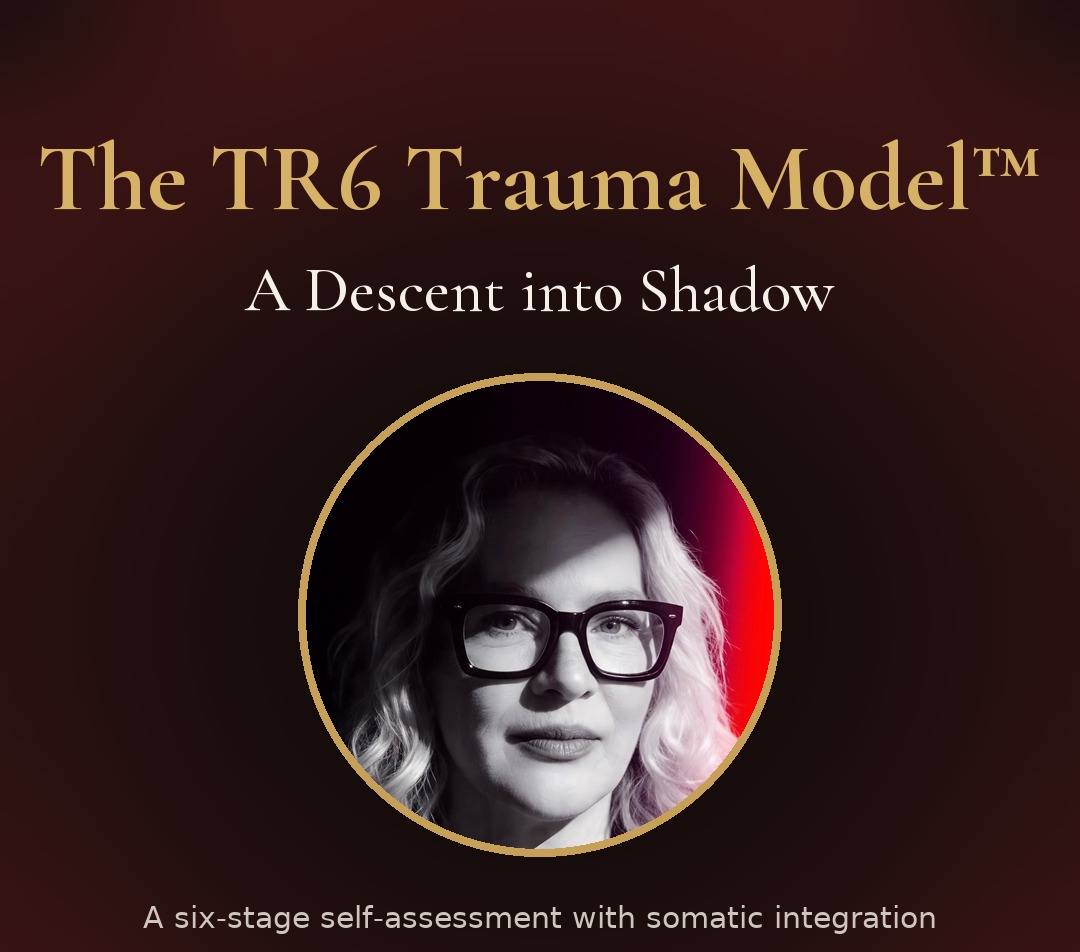
What happens when trauma is no longer simply about what happened, but about what remains unresolved, repeatedly reactivated and woven into the way a person now experiences themselves, other people and the world?
Why do some people thrive in spite of complex trauma and significant adversity, yet others continue to suffer, become unwell, even die? That question became the foundation of my life's most significant body of work: the TR6 Trauma Model™: Descent into the Shadow.
TR6 is a non-diagnostic model developed to understand complex and relational trauma not simply as a collection of symptoms, but as a dynamic process in which people can move, adapt, become caught, regress, recover and reconstruct meaning.
The six stages
Reconciliation. Re-Injury. Rumination. Resentment. Rage. Revenge.
Each can contain adaptive and maladaptive responses. The purpose is not to label a person as damaged or disordered, but to ask something more clinically and humanly useful:
Where are they now? What is keeping them there? What is still hidden or denied, trying to be understood, integrated, expressed or transformed?
Stage 1
Lack of Reconciliation
The struggle to reconcile the irreconcilable; an open wound and the seeking of ambiguous closure.
Stage 2
Re-Injury
The repetition of harm through conditioned lack of boundaries, fawning, or appeasement; reinforced by cultural and family obligations, celebrations, and ongoing entanglement with what first caused the injury.
Stage 3
Ruminations
Obsessive loops of “why”; the mind circling endlessly without resolution as an attempt to regain control, a defence against the despair of accepting the starkness of what is.
Stage 4
Resentment
Embodied embitterment: the weight of unresolved pain that could not be discharged.
Stage 5
Rage
The psyche’s protest, against the violations that demand truth. Rage acts as the ultimate boundary. Suppressed or explosive anger is the rupture of truth, long denied expression, that masks deep pain and hurt, the anguish of powerlessness that structure the beliefs, perpetuating a victim’s identity.
Stage 6
Revenge
The drive to restore dignity, identity, control, power, retribution and at its rawest form, survival under the collapse of self/identity.
Each of the six stages includes both healthy expressions (above the line) and warning signs of emotional/embodied entrapment (below the line).
We use the language of post-traumatic stress very readily, yet for many people living with relational trauma, the trauma is not "post." A person may still be emotionally, financially, physically, culturally or mentally tethered to ongoing obligatory rules and abuse.
Even if the relationships have ended, their psychological unravelling may continue, especially after relationships with narcissistic or psychopathic personalities. A person may have left the family system but still carry its rules or secrets. The person who stands for truth, succeeds or refuses to hold secrets may be collectively punished through scapegoating or gaslighting.
Betrayal and moral injury can have a lasting impact on trust, identity, attachment and safety in the world. Even when danger has passed, the nervous system can continue to behave as though threat remains.
A person can hold the duality of functioning while living in various TR6 territories of unresolved complexity they have not yet been able to articulate, acknowledge or truly sit with. These layers can be deeper than conscious awareness.
There is an enormous space between surviving an experience and becoming free of its organisation of your life. That is the space TR6 was created to explore.
Chronic unresolved trauma can carry profound psychological and physiological burden: depression, addiction, chronic stress states, suicidality, relational collapse, somatic distress and a life increasingly organised around survival rather than freedom.
The framework took approximately three years to formally develop, but represents the accumulation of ideas, observations and clinical methods from decades of psychotherapy practice. I undertook a two-year practice-based comparative evaluation involving ten therapists, each working with five clients, in which TR6 was examined alongside five established assessment approaches.
I wanted it tested in practice. I wanted other therapists to use it. I wanted clients to experience it themselves. The outcome of that independent study and external critique appears in my book, TR6 Trauma Model: Descent into the Shadow.
I then placed the conceptual framework before anonymous academic peer review. The TR6 Trauma Model was accepted for publication in the Australian Counselling Research Journal following academic review, Volume 19, Issue 1, 2026. I wanted the work examined from more than one position: clinically, conceptually, experientially and academically.
Trauma as an existential crisis
TR6 is paired with existentialism because relational and complex trauma can be an existential crisis. Healing may require navigating ambiguity, nuance, injustice, betrayal, moral injury, sadism and deeply distorted experiences that require a reworking of the soul.
If you are spiritual, you may understand this instantly. If you are religious, there is space for alignment. If you are agnostic or atheistic, it may be a dance with the mind that bends into new perspectives, renewed narratives, self-agency and resilience. Existentialism holds space for us all.
Trauma can alter a person's relationship with morality, justice, belonging, intimacy, safety and meaning. It can change the ground from which a person understands their own life.
Sometimes the most important therapeutic question is not, "How do I make this symptom stop?"
It is, "Who have I become because of it?"
"What's underneath?"
And eventually, "Who am I capable of becoming beyond it?"
I am now 62, with almost 32 years of clinical work behind me, and remain deeply motivated by this field. At this point in my professional life, I am particularly interested in contribution. What have decades of sitting beside trauma taught me? What can be articulated more clearly? What might we be overlooking? What can I leave behind that helps people understand suffering without immediately reducing it to pathology?
The TR6 assessment is freely available because I want people to have access to that language and map. The larger system is explored through the book, and professional training will allow therapists to work with the framework in greater depth. The larger purpose of this work is conversation.
I welcome opportunities to explore trauma that is not truly "post," relational and complex trauma, betrayal and moral injury, psychological ties to experiences people have physically left, rumination, resentment, rage and revenge, adaptive and maladaptive emotional states, the shadow, over-pathologising human suffering, and the existential work of reconstructing identity and meaning after trauma.
I welcome podcasts, interviews, panel discussions, professional forums, articles, collaborations and broader conversations. We need models that can hold both science and lived experience, recognise pathology when it is present, and not mistake every painful human response for disorder.
We need models that give agency back to the person who holds the greatest healing within, the only person who should answer the question, "Who am I?"
What happened? What remains unfinished? Where are we stuck?
What is already moving? Where are we thriving?
What might freedom actually look like from here?
Deirdre Rolfe
Creator of the TR6 Model, author and psychotherapist